
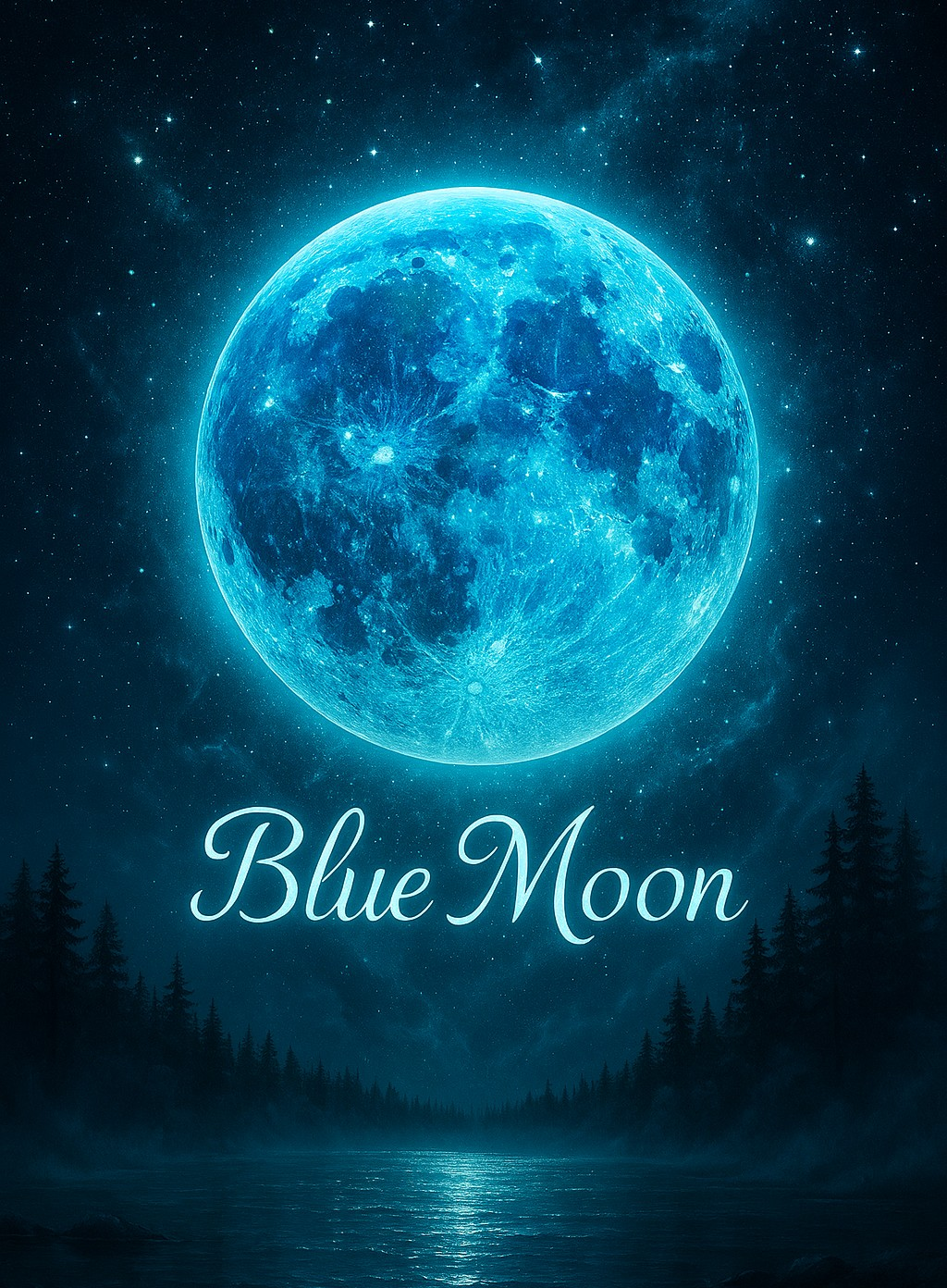
If you plan to observe these full moons, clear skies and minimal light pollution will provide the best viewing experience. Enjoy the celestial event!
This will be a seasonal blue moon. A seasonal blue moon is the third full moon that occurs in an astronomical season that has four full moons. Astronomical seasons are defined by the dates of the equinoxes and solstices, such as the winter solstice marking the beginning of winter and the spring equinox marking the beginning of spring. Normally, each season (spring, summer, fall, and winter) has three full moons. When a season includes a fourth full moon, the third one is called a Blue Moon. A seasonal blue moon usually happens between the summer solstice and the fall equinox.
The term “blue moon” has nothing to do with the moon’s color. However, the moon can appear blue in rare cases when particles in the atmosphere are slightly wider than the wavelength of red light, allowing blue light to pass through. For example, after a volcanic eruption, the moon can appear bluish for years due to the smoke and dust particles released into the air.

Historical Information
This definition of a Blue Moon is rooted in ancient European traditions. The concept was formalized in the early 20th century by the Maine Farmers’ Almanac. The seasonal Blue Moon was traditionally used to maintain the alignment of the lunar calendar with the solar year, ensuring that agricultural and seasonal activities remained in sync.
The Mystique of the Blue Moon Explained Further
In the realm of celestial phenomena, few terms evoke as much intrigue and curiosity as the “Blue Moon.” Despite its evocative name, a Blue Moon is not characterized by any actual change in color but is rather a rare timing phenomenon within the lunar cycle.
The Basics of the Lunar Cycle
Before we dive into the specifics of a Blue Moon, it’s essential to understand the basic lunar cycle. The Moon orbits Earth approximately every 29.5 days, a period known as a synodic month. This cycle begins with the New Moon, progresses through the First Quarter, Full Moon, and Last Quarter phases, and returns to New Moon.
Given that the lunar cycle is about 29.5 days and most calendar months are either 30 or 31 days long, a calendar month can occasionally accommodate two full moons. This alignment is central to one of the definitions of a Blue Moon.

Blue Moon Defined
The term “Blue Moon” can refer to different phenomena, and understanding these definitions provides clarity on what makes a Blue Moon so special.
The Monthly Blue Moon
The most widely recognized definition of a Blue Moon is the occurrence of a second full moon within a single calendar month. This definition is relatively recent, dating back to the 20th century. The lunar cycle of approximately 29.5 days means that most months will have only one full moon. However, occasionally, the timing aligns such that two full moons fall within the same month. When this happens, the second full moon is termed a Blue Moon.
The concept of the Blue Moon as the second full moon in a month became popular through a 1946 article in Sky & Telescope, written by James Hugh Pruett. Pruett’s interpretation, based on a misreading of an earlier astronomical almanac, suggested that the Blue Moon was the second full moon in a month. This definition was later popularized and widely adopted.
The Color of the Blue Moon
Despite the name, a Blue Moon does not actually appear blue. The term “Blue Moon” is a figurative expression rather than a literal one. The Moon can only appear blue under rare atmospheric conditions, such as during volcanic eruptions or large-scale dust storms. These events scatter red and yellow wavelengths of light, allowing the shorter blue wavelengths to become more visible.
Notable Blue Moon Events:

The eruption of Krakatoa in Indonesia in 1883 is one of the most famous instances where the Moon appeared blue. The volcanic ash and dust in the atmosphere scattered sunlight, making the Moon appear bluish for several months following the eruption.
The 1950 Blue Moon: A more recent example occurred in 1950, when a series of dust storms in the American Midwest created conditions that made the Moon appear blue.
While such events are extraordinary and not related to the timing of a Blue Moon, they illustrate that the Moon’s color can change under specific circumstances.
Cultural and Historical Significance
The Blue Moon has captured the imagination of people for centuries. Its rarity and the mystical connotations associated with its name have made it a subject of folklore, literature, and art.
Folklore and Mythology:

Various cultures have myths and legends associated with the Moon. The Blue Moon, due to its rarity, has often been linked to superstitions and beliefs. In some cultures, a Blue Moon is considered an omen or a symbol of significant change. For example, some Native American tribes referred to the Blue Moon as a time of transformation and renewal.
The moon is often linked to women’s mysteries, intuition, and the divine qualities of the sacred feminine. In some modern magical traditions, the Blue Moon symbolizes the growth of knowledge and wisdom throughout a woman’s life. Other groups view the Blue Moon as a time of increased clarity and connection to the Divine due to its rarity. Rituals performed during a Blue Moon may receive a magical boost, especially when engaging in spirit communication or developing one’s psychic abilities.
The earliest reference to a blue moon is from a 1528 proverb that says, “If they say the moon is blue, We must believe that it is true”. The phrase later evolved to signify “never.” In the 18th century, saying “I’ll marry you, m’lady, when the Moon is blue!” would have been a fancy way of saying I’ll never marry you. The term “blue moon” may have also originated in 1883 after the eruption of the Krakatoa volcano in Indonesia.

Literature and Popular Culture:
The Blue Moon has also made its mark in literature and music. One of the most famous references is the song “Blue Moon,” written by Richard Rodgers and Lorenz Hart in 1934. The song’s lyrics reflect the idea of rarity and longing, capturing the essence of the Blue Moon as a unique and poignant event. The song has been covered by numerous artists and remains a classic.
In addition to music, the Blue Moon has appeared in various literary works, films, and television shows, often symbolizing magic, mystery, or rare opportunities. The phrase made an appearance in a 1821 book about working-class London, where a character says, “I haven’t seen you this blue moon”
Scientific Perspective:
From a scientific standpoint, the Blue Moon is a purely calendrical phenomenon. It does not involve any unique astronomical events or conditions. The concept of the Blue Moon arises from the alignment of the lunar phases and the calendar, rather than any physical changes in the Moon itself.

Lunar Phases and Calendar Alignment:
To understand the scientific basis for a Blue Moon, it’s helpful to look at the lunar phases and their relationship with the calendar. The Moon’s phases are a result of the relative positions of the Earth, Moon, and Sun. The timing of these phases can sometimes lead to the occurrence of two full moons in a single calendar month or four full moons in a single season.
Calendrical Systems and the Blue Moon:
The Blue Moon’s rarity is a result of the interaction between the lunar cycle and the Gregorian calendar. The Gregorian calendar, which is the most widely used calendar system, is based on a solar year of approximately 365.24 days. This calendar does not align perfectly with the lunar cycle, which is about 29.5 days long. As a result, the alignment of full moons with calendar months can vary, leading to occasional Blue Moons.
Frequency of Blue Moons
The frequency of Blue Moons can be surprising. On average, a Blue Moon occurs approximately every 2 to 3 years. This is due to the alignment of the lunar cycle and the calendar, which creates the conditions for a Blue Moon to occur.

Observing a Blue Moon
For those interested in observing a Blue Moon, the event is similar to observing any other full moon. The Moon will appear as a typical full moon in terms of its size and brightness. The main difference is the timing and rarity of the event.
Tips for Observing:
- Check the Calendar: Ensure that you know the exact dates of the full moons in the month or season. This will help you identify when a Blue Moon is occurring.
- Find a Good Viewing Spot: Choose a location with minimal light pollution for the best viewing experience. While the Moon itself will not appear blue, a clear, dark sky will enhance your observation.
- Photography: If you’re interested in capturing the Blue Moon on camera, use a telephoto lens to get a closer view. The Moon’s appearance will be similar to other full moons, so standard lunar photography techniques apply.
Leave a Reply
You must be logged in to post a comment.